
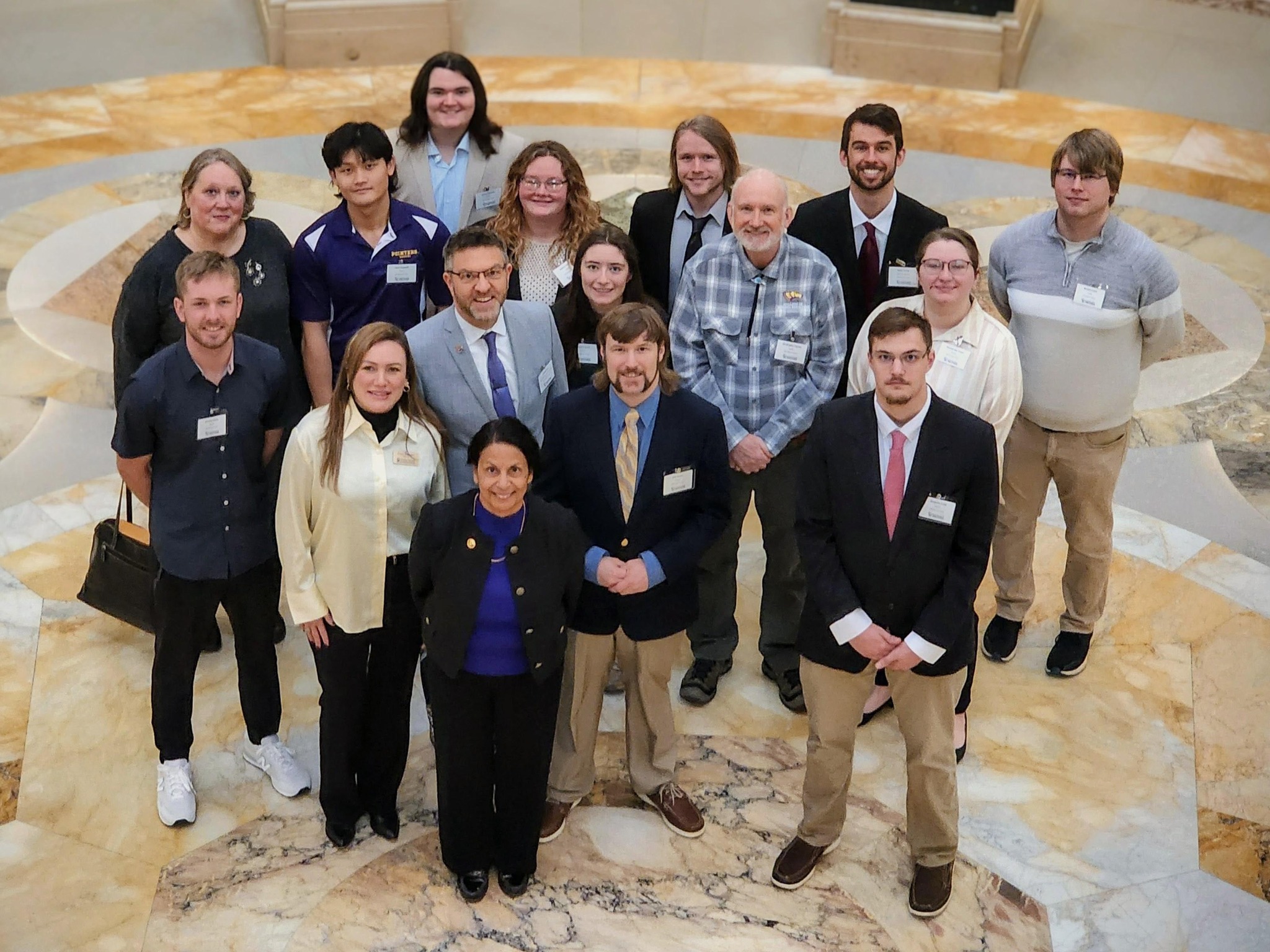
Undergraduate researchers from UW-Stevens Point were among an elite group of students representing the Universities of Wisconsin at the 22nd annual Research in the Rotunda on March 11 at the State Capitol in Madison. Their work showcased the wide impact of student scholarship, from community health and substance access to the future of consumer behavior in an AI-driven world.
Nik Pontzloff, a health science and wellness major on the pre-physical therapy track, presented “Wood County THC Community Environment Surveillance Scan, 2025” under the mentorship of Legacy Endowed Professor of Population Health Tami Swenson. His project revealed a sharp rise in Wood County retailers selling intoxicating hemp products such as Delta-8, Delta-10 and THC-A. After scanning 244 potential retailers through online searches, social media reviews and state licensing records, 76 were confirmed to sell THC products. This marks a 245 percent increase from 2023. [View Photos]
Brandon Shoen, a Sentry School of Business and Economics student, also presented his research “Consumer Motivation Through AI Experiences: A Study Involving Brand Trust and Purchase Decision.” Supervised by Assistant Professor of Marketing Fran Reinert Ce, Shoen’s work examines how consumers respond to AI chatbots based on their motivational orientation. [View Photos]
Together, these UW-Stevens Point projects highlight the depth and range of student scholarship. From protecting youth in local communities to shaping the future of ethical AI design, UWSP students are creating research that informs policy, strengthens practice and inspires meaningful change.
“Consumer Motivation Through AI Experiences: A Study Involving Brand Trust and Purchase Decision”
Abstract: As artificial intelligence (AI) continues to reshape digital service encounters, understanding how consumers with different motivational orientations respond to chatbot features has become increasingly important. This study examines whether AI chatbots influence consumers based on their hedonic and utilitarian motivations, utilizing two primary stimuli: social presence and AI accuracy. Building upon current research on consumer-AI interaction and motivation theory, we hypothesized that consumers motivated by hedonism respond positively to both social presence and perceived accuracy of AI chatbots. Furthermore, utility-motivated consumers are expected to value functional attributes – such as precision and efficiency – while demonstrating little to no positive response to heightened social presence, which may be perceived as intrusive or counterproductive. Thus, this research proposes a moderated trust-based framework explaining how chatbot features shape brand trust and purchase decision-making, through a consumer survey distributed primarily to Gen Z and millennial respondents aged 18 and older. To analyze the data, confirmatory factor analysis and structural equation modeling (SEM) will be applied to prove the relationships hypothesized in the framework. By clarifying these relationships, this study contributes to both theory and practice by informing more effective and ethically responsible chatbot design strategies that foster long-term consumer trust—particularly among younger digital-native consumers.
“Wood County THC Community Environment Surveillance Scan, 2025”
Abstract: The Wood County THC Community Report project looked at THC and intoxicating hemp (such as Delta-8, Delta-10, and THC-A) product availability in Wood County, Wisconsin. The project conducted a three-phase environmental scan of THC retailers by investigating online websites, social media pages, and state licensing records to locate potential retailers and identify products offered; phone interviews with retailers to verify sales information and clarify product types; and in-person visits to confirm findings, observe store layouts, check for age verification measures, and, when possible, speak with owners or managers. Of 244 potential retailers, 76 were confirmed to sell THC (intoxicating hemp) products, a 245% increase from the 22 retailers identified in 2023. Based on initial phone conversations with retailers who do not sell but indicated that they will sell in the future, this number is expected to continue to increase over the next few years. Other major findings included: 25% of the identified THC retailers are Bars and Taverns; 20% of the scanned retailers sold intoxicating mushroom products; several stores scanned in-person did not restrict access to products for individuals under 21; a clerk offered free THC vape samples to an underage individual while vaping at the counter; and one retailer reported that they had 12 attempts by underage individuals to make purchases in the last month. Inconsistent age verification and sales raised concerns about youth access. The findings from this report were used by the Wood County IMPACT team members to develop additional tools with local businesses to help monitor age compliance checks for Wood County Ordinance #236.05 restricting sale of THC products for persons under the age of 21.