

The labor market has been an economic focus recently for multiple reasons, including weak-to-nonexistent job growth and large revisions to labor market data. Last August, President Trump fired the head of the Bureau of Labor Statistics after a disappointing jobs report was released that included downward job growth revisions for previous months.
A variety of government agencies collect economic data, including the Bureau of Labor Statistics (BLS), the Bureau of Economic Analysis (BEA), the U.S. Census Bureau, and the Federal Reserve. The BLS collects a variety of data on the labor market, including total nonfarm employment, job growth, hours, the unemployment rate, wages, industry employment, and employment for different demographics. This blog will focus on recent job growth revisions, the implication of the revisions, and why revisions occur.
The Revisions and Implications
In February, the BLS released its annual revision to national estimates of employment, hours, and earnings from the Current Employment Statistics (CES) monthly survey of nonfarm establishments.
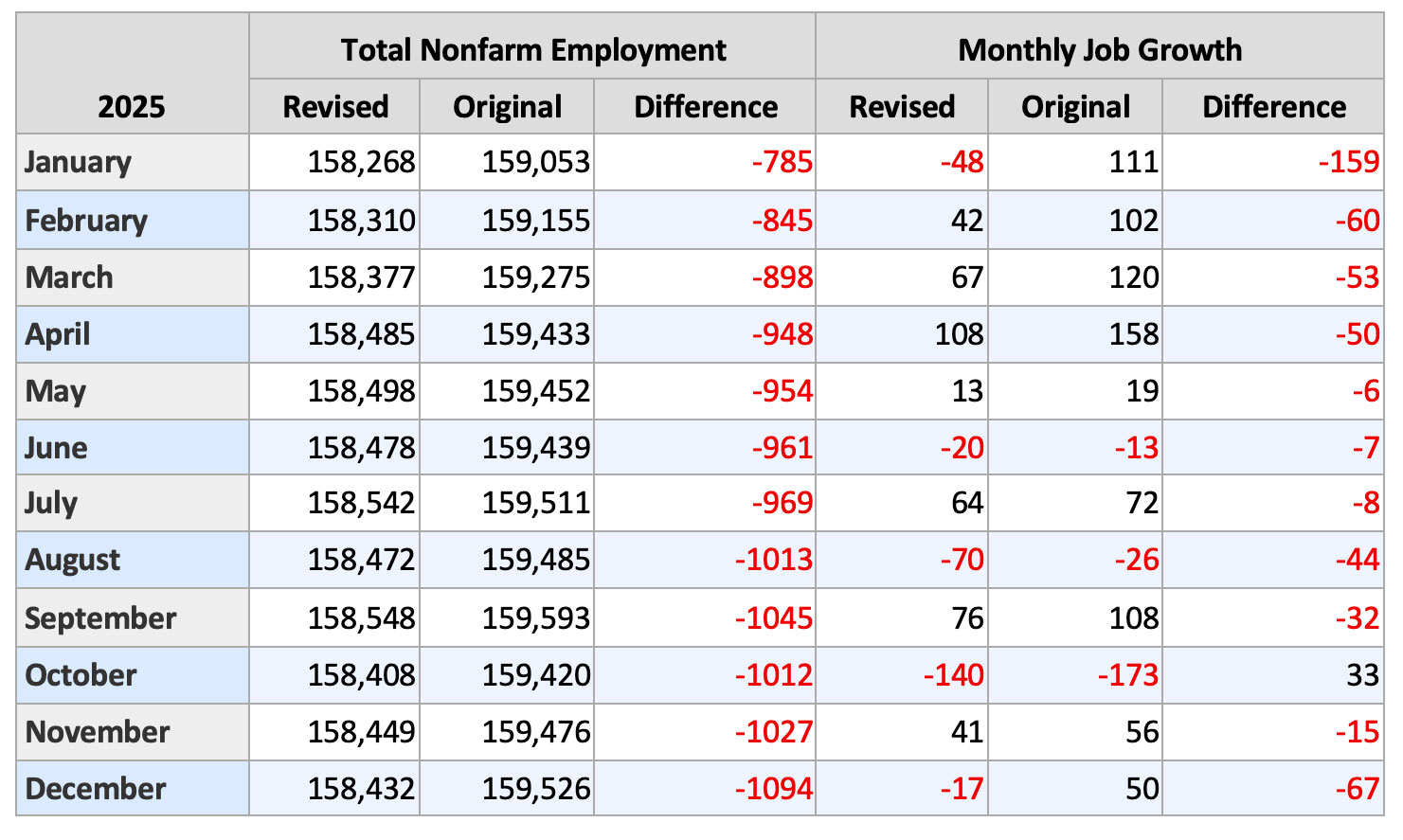
The table below shows the revised and originally released numbers for monthly total nonfarm employment and monthly job growth in 2025, and the difference between the revised and original numbers. The implication of the revised numbers is clear – the labor market was weaker than initially indicated. Total nonfarm employment was revised downward in every month, with revisions indicating that total nonfarm employment was over 1 million less than originally stated in each month beginning in August. Monthly job growth was lower than originally indicated in 11 out of 12 months, with only October having a revised increase showing fewer jobs lost than originally stated. Job losses occurred in two out three months in the last quarter of 2025, with December having a job loss of 17,000 jobs.
Revisions to 2025 Monthly Total Nonfarm Employment and Monthly Job Growth (in thousands)
For the entire year, only 116,000 jobs were added in 2025, the sixth worst year for job growth this century (with job losses occurring in 2001, 2002, 2008, 2009, and 2020).
Annual Job Growth (in thousands) since 2000
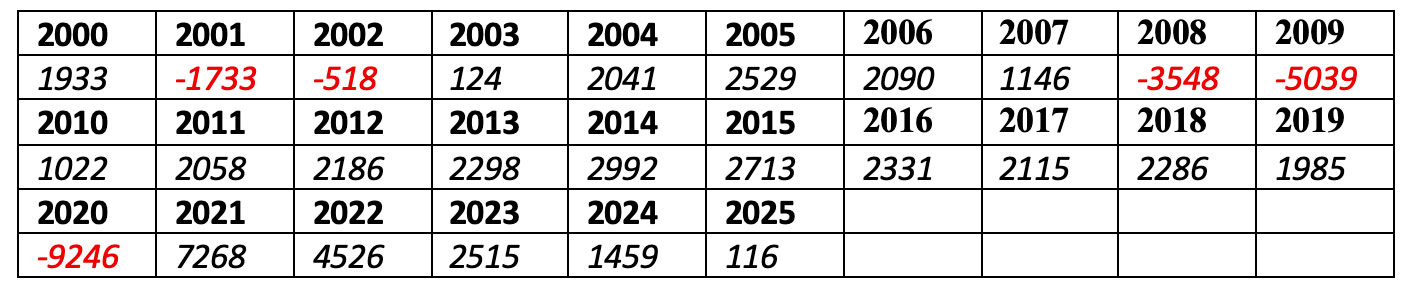
Preliminary numbers for 2026 included job growth of 126,000 in January and a job loss of 92,000 in February.
The Reasons for Labor Market Data Revisions
It’s a balancing act for government agencies when collecting economic data and releasing the data to the public. The accuracy of the data is extremely important, but so is the timeliness of the data release, with preliminary data released to provide a snapshot of current economic conditions. Preliminary data is an estimate based on incomplete information, with a given number representing a best guestimate based on available information, subject to revision. Preliminary data released and subject to revision includes labor market information and economic (gross domestic product (GDP)) growth estimates. Initial releases of data focus on timeliness with accuracy subject to incomplete information, while revisions can prioritize accuracy as more complete data is received.
The Bureau of Labor Statistics releases monthly Employment Situation reports, including jobs numbers, on the first Friday of every month. The monthly jobs report reflects preliminary jobs numbers for the previous month based on employer surveys. The monthly Current Employment Statistics (CES) survey uses a sample of over 100,000 businesses and government agencies to collect employment data. The BLS uses extrapolation and estimation techniques to produce monthly employment totals for the entire economy.
The CES is a survey and is a sample of the labor market; it is not a census of the entire labor market. As such, it is subject to survey inaccuracies. The jobs numbers for a given month are revised based on surveys received after the preliminary numbers have been released. The BLS follows a standard process for data revision. The first revision to jobs numbers occurs one month after the initial release, with a second revision occurring two months after the initial release. In each case, jobs numbers are updated reflecting additional surveys and corrected information received from employers.
A monthly household survey (Current Population Survey) is also used by the BLS. The survey of approximately 60,000 households is used to derive the unemployment rate and focuses on individual labor force status, while the CES survey provides a more definitive counting of jobs and hours worked, in total and in specific industries.
There are two rates important for the Current Employment Statistics survey used for employers: the response rate and the collection rate. The response rate measures the percentage of employers selected for the CES who agree to participate and provide data. The response rate has recently declined substantially, dropping approximately 20 percentage points since the early 2010s to only 42% in March 2025. The declining response has been a contributing factor to significant jobs number revisions. The collection rate measures how many participating employers respond in time for the monthly Employment Situation release. In 2024, the collection rate was approximately 60% for first preliminary estimates, 89% for second, and 91% for the third and final survey estimate.
Employer surveys used by the BLS are viewed as estimates for the labor market, including total employment and job growth, as surveys may have incomplete or inaccurate information. Once a year, usually in February, the BLS will benchmark the labor market information obtained from employer surveys against a more comprehensive, accurate source of information, the Quarterly Census of Employment and Wages (QCEW). The QCEW is a joint effort between the BLS and state unemployment insurance programs. The QCEW provides a comprehensive tabulation of employment information, and publishes a quarterly count of employment and wages reported by employers covering more than 95 percent of U.S. jobs, available at the county, metropolitan, state and national levels by industry. The QCEW uses quarterly tax reports that employers are required to file with state workforce agencies as part of the unemployment insurance system. Benchmarking to the QCEW may result in significant revisions to earlier released jobs numbers for the previous year.
Summary
For a variety of reasons, economic trends are more important than the data in any one month, and multiple measures should be used when gauging the performance of the U.S. economy. It’s a balancing act for government agencies when collecting economic data and releasing the data to the public. The accuracy of the data is extremely important, but so is the timeliness of the data release, with preliminary data released to provide a snapshot of current economic conditions. Initial releases of data focus on timeliness with accuracy subject to incomplete information, while revisions can prioritize accuracy as more complete data is received. Analyzing the U.S. economy through trends and a variety of measures minimizes the data inaccuracy and incompleteness of any one measure.
The BLS monthly jobs reports, released on the first Friday of each month, reflect preliminary jobs numbers for the previous month based on employer surveys, and are subject to revision – for good reason. The CES is a survey and is a sample of the labor market; it is not a census of the entire labor market. As such, it is subject to survey inaccuracies. The jobs numbers for a given month are revised based on surveys received after the preliminary numbers have been released. The first revision to jobs numbers occurs one month after the initial release, with a second revision occurring two months after the initial release. In each case, jobs numbers are updated reflecting additional surveys and corrected information received from employers.
Once a year, usually in February, the BLS will benchmark the labor market information obtained from employer surveys against a more comprehensive, accurate source of information. Additional revisions may occur to prior year jobs numbers when survey data is benchmarked against the Quarterly Census of Employment and Wages (QCEW), a more complete and accurate measure of labor market data. The QCEW provides a comprehensive tabulation of employment information, and publishes a quarterly count of employment and wages reported by employers covering more than 95 percent of U.S. jobs.
In February, the Bureau of Labor Statistics (BLS) released its annual revision to national estimates of employment, hours, and earnings from the Current Employment Statistics monthly survey of nonfarm establishments. The implication of revised jobs numbers for 2025 indicates that the labor market was weaker than initially indicated. Total nonfarm employment was revised downward in every month, with revisions indicating that total nonfarm employment was over 1 million less than originally stated in each month beginning in August. Monthly job growth was lower than originally indicated in 11 out of 12 months in 2025.
For further information:
From the Bureau of Labor Statistics, various information on data collection and revisions:
- CES National Benchmark Article, Feb. 2026: U.S. Bureau of Labor Statistics
- Current Employment Statistics Preliminary Benchmark Summary, Sept. 2025: BLS
- Bureau of Labor Statistics Data – Total Nonfarm Employment, One Month Change
- CES Frequently Asked Questions
- Declining Response Rate – Answers Don’t Come Easy | Richmond Fed
- Employment by industry, monthly changes, with confidence intervals
- Household and establishment survey response rates: U.S. Bureau of Labor Statistics
- CPS Response Rate : U.S. Bureau of Labor Statistics

Kevin Bahr is a professor emeritus of finance and chief analyst of the Center for Business and Economic Insight in the Sentry School of Business and Economics at the University of Wisconsin-Stevens Point.