

Overview
In August, the Treasury announced that it will at least double the size of its “liquidity support” for Treasury bonds. The increased liquidity support means that the Treasury is boosting the size of Treasury bond buyback operations with the goal of lowering long-term interest rates. The maximum size of each Treasury bond buyback rises from $2 billion to at least $4 billion, with the purchases targeting Treasury bonds with 10 to 30 years left to maturity. The larger operations are expected to occur through early November.
The Treasury actions are in response to rising bond yields (long-term interest rates), which increase financing costs for consumers and businesses. The new Treasury operations increase the demand for Treasury bonds, which puts upward pressure on bond prices and consequently lowers their yield (interest rate). There is an inverse relationship between bond prices and yields; an increase in bond prices lowers bond yields and a decrease in bond prices increases bond yields. The yield on 30-year Treasury bonds hit their highest level since 2007 before the Treasury announcement.
This blog will discuss the role of the Treasury and Federal Reserve in conducting Treasury bond purchases, provide a recent history of long-term interest rates, and provide reasons for the recent rise in long-term interest rates.
The Treasury, The Federal Reserve and the Purchase of Treasury Bonds
The Treasury’s announcement of increasing bond purchases to influence long-term interest rates was a surprise to the bond market, as the Treasury gave no previous indication that it would double its bond purchases. It also blurs the line between what the Federal Reserve is responsible for and what the Treasury is responsible for.
A primary responsibility of the Federal Reserve is monetary policy, which is conducted through open market operations – the buying and selling of Treasury securities to change financial market interest rates, which in turn influences economic growth. The Federal Reserve is charged (by Congress) with the dual mandate of achieving maximum employment and price stability. To accomplish these objectives, the Federal Reserve targets the federal (fed) funds rate by controlling the money supply. The fed funds rate is the overnight borrowing rate between banks, a very short-term interest rate that when changed, typically has a rippling effect through the financial markets. The fed funds rate is generally decreased to foster economic growth through greater consumer and business demand enabled by lower borrowing costs. The fed funds rate is generally increased in periods of relatively high inflation to lower consumer and business demand to put downward pressure on prices.
The fed funds rate is increased when the Federal Reserve decreases the money supply by selling Treasury securities (technically called Open Market Operations). The fed funds rate is decreased when the Federal Reserve increases the money supply by buying Treasury securities. Changes in the fed funds rate generally affect savings and borrowing rates. Although open market operations were historically used to primarily target short-term interest rates, following the financial crisis of 2008 the Federal Reserve greatly expanded its holding of longer-term securities through open market purchases of Treasury bonds with the goal of putting downward pressure on longer-term interest rates to stimulate economic growth.
A primary responsibility of the U.S. Treasury is managing the federal government’s finances, including: issuing debt to fund federal budget deficits, collecting taxes, supervising financial institutions, enforcing finance laws, producing currency, and paying bills. A key component of the Treasury’s responsibilities is the issuance of government debt to fund federal budget deficits, which occurs when the amount of U.S. federal government spending exceeds government income. To finance a budget deficit, the Treasury borrows money from the public through the issuance of U.S. government debt called U.S. Treasury securities. Treasury securities include both marketable and non-marketable securities. Marketable securities trade in the (secondary) financial markets, and include Treasury bills, notes, bonds, and Treasury Inflation-Protected Securities (TIPS). The securities have different terms and provisions, but it’s all debt. Treasury non-marketable securities include savings bonds as well as special securities issued only to state and local governments. Non-marketable securities are not traded in financial markets.
Although the Treasury and Federal Reserve can both purchase government (Treasury) bonds, traditionally the role of the Treasury has differed from the Federal Reserve. Purchasing Treasury securities is a primary function of the Federal Reserve and a secondary function for the Treasury. The Treasury conducts Treasury bond buybacks as a fiscal (debt management) tool with the objectives of improving bond market liquidity, stabilizing long-term yields, and optimizing the maturity structure of U.S. government debt. Although its purchase of bonds can influence long-term interest rates, Treasury actions generally are limited in scope to between $2 billion and $4 billion per buyback operation, much smaller than potential Federal Reserve actions. The Treasury cannot create money; the purchase of government bonds is financed through two sources – taxes or borrowing. The Treasury can sell short-term securities and use the proceeds to purchase long-term securities, consequently putting upward pressure on short-term rates while decreasing pressure on long-term rates.
When implementing monetary policy, the Federal Reserve utilizes bond buybacks to increase the money supply and lower interest rates. Although the Federal Reserve focuses on the fed funds rate, a short-term rate which is the overnight borrowing rate between banks, the Fed can influence both short and long-term interest rates through the purchase of Treasury securities. “Quantitative easing” (QE) has been used by the Federal Reserve in extraordinary financial times (the financial crisis of 2008 and COVID 2020 recession) to lower long-term interest rates. The primary purpose of quantitative easing is to stimulate economic growth through the reduction of long-term interest rates by the large-scale purchase of Treasury securities. The Federal Reserve bought more than $5.6 trillion of Treasurys through its QE programs between 2008 and 2023.
The Bond Market – Recent Interest Rate History
Bonds are a type of borrowing. The issuer of the bond (borrower) promises to pay the bond buyer periodic interest and the principal value of the bond at maturity. The interest rate on bonds is determined by the interaction of the demand for bonds by investors and the supply of bonds by borrowers. Bond market investors include individuals and institutional investors, which include governments, pension funds, mutual funds, hedge funds, financial institutions, and corporations. Borrowers include governments and corporations. An increase in the supply of bonds (more borrowing by the government and corporations) puts upward pressure on interest rates, as higher interest rates are needed to attract more money from investors. A decrease in the supply of bonds lowers interest rates, as less money is needed from investors. An increase in the demand for bonds will put downward pressure on interest rates, as more money is available for borrowers. A decrease in the demand for bonds increases interest rates, as higher interest rates are needed to attract more money from investors.
Specific factors affecting the required interest rate on a bond by investors include inflation, the default risk of the bond, and the maturity of the bond. Investors need to have an interest rate on the bond greater than inflation, otherwise their purchasing power will decline. The greater the default risk, the greater the interest rate on the bond required by investors, as investors need to be compensated for the possibility of not receiving interest and principal if the bond defaults. The maturity of the bond affects the interest rate risk of the bond. The interest rate risk of a bond is the potential for a bond’s market value to decline due to rising interest rates. There is a mathematical, inverse relationship between market interest rates and bond prices. If market interest rates increase, then bond prices will decline. Generally, the longer the maturity the greater the sensitivity (price change) to changes in market interest rates, other factors held constant.
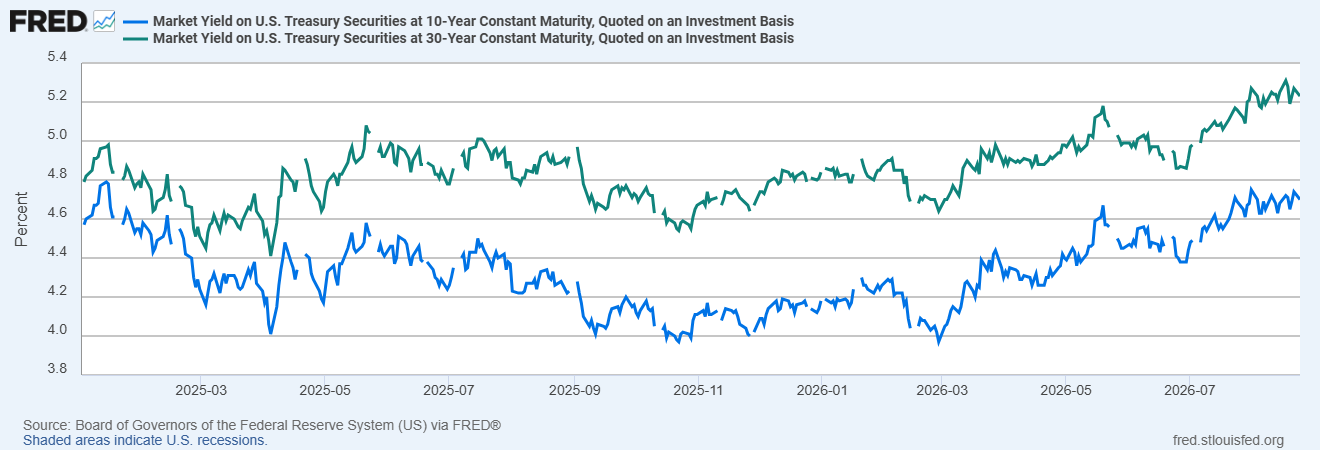
In August, the Treasury announced that it will buy Treasury bonds with the goal of lowering long-term interest rates in the financial markets, with the purchases targeting Treasury bonds with 10 to 30 years left to maturity. The chart below shows the market yield for Treasury securities with a 10-year maturity (blue line) and 30-year maturity (green line) between January 1, 2025 and August 26, 2026. Although the spread (the difference between) the 30-year yield and 10-year yield can fluctuate due to market factors, generally the yield will be higher on 30-year Treasury bonds than on 10-year Treasury bonds. This is due to multiple factors, including: 1) a term premium, investors want more return for the uncertainty of investing longer term, 2) inflation risk, there is more inflation risk over 30 years compared to 10 years, 3) interest rate risk, 30-year bonds have greater price volatility than 10-year bonds if market interest rates change, and 4) differences in the demand and supply of 30-year bonds relative to 10-year bonds.
After declining in the second half of 2025, the yield on both 10-year and 30-year Treasury bonds generally began trekking upward in 2026. On February 27 both the 10-year and 30-year Treasury bond yields hit year-to-date lows, with the 10-year Treasury bond yield bottoming out at 3.97% and the 30-year Treasury bond yield hitting 4.64%. Since then, the 2026 trend has generally been up, and in August the 10-year Treasury bond yield hovered around 4.70% while the 30-year Treasury bond yield hit its highest level in 19-years, topping 5.30%. Following the Treasury announcement on August 19, the 10-year bond closed down 6 basis points to 4.65% and the 30-year bond dropped 9 basis point to 5.19%. A basis point equals 0.01%.
Market Yield on 10-Year and 30-year Treasury Securities
January 2025 – August 2026
Increasing market yields on Treasury securities affect the borrowing costs for consumers (including homebuyers) and businesses. Consumer loans that may be tied to the interest rate on long-term Treasury securities include auto loans, student loans, and home equity loans. Rising interest rates can dampen economic growth as increased financing costs will lower the demand for products by consumers and businesses, and make home ownership even more unaffordable.
There is generally a link between risk and return in financial markets. More risk, requires more return by investors. Treasury securities have typically been viewed as a relatively safe by investors, as Treasury securities are theoretically backed by the full faith and credit of the U.S. government for payment. Corporate bonds have greater default risk; consequently, corporate bonds have a higher yield than Treasury bonds for a given maturity as investors require more return to compensate for default risk. Mortgage loans have greater risk than corporate bonds, consequently mortgage interest rates will be higher than corporate bond interest rates.
The chart below shows the 30-year fixed rate mortgage average (blue line), the market yield on 30-year Treasury bonds (green line), and the market yield on AAA corporate bonds (brown line) with a maturity of at least 20 years. AAA corporate bonds are debt securities issued by financially strong corporations with the highest credit rating indicating minimal default risk.
30-Year Fixed Rate Mortgage Average, Market Yield on 30-year Treasury Securities, AAA Corporate Bond Yield
January 2025 – August 2026
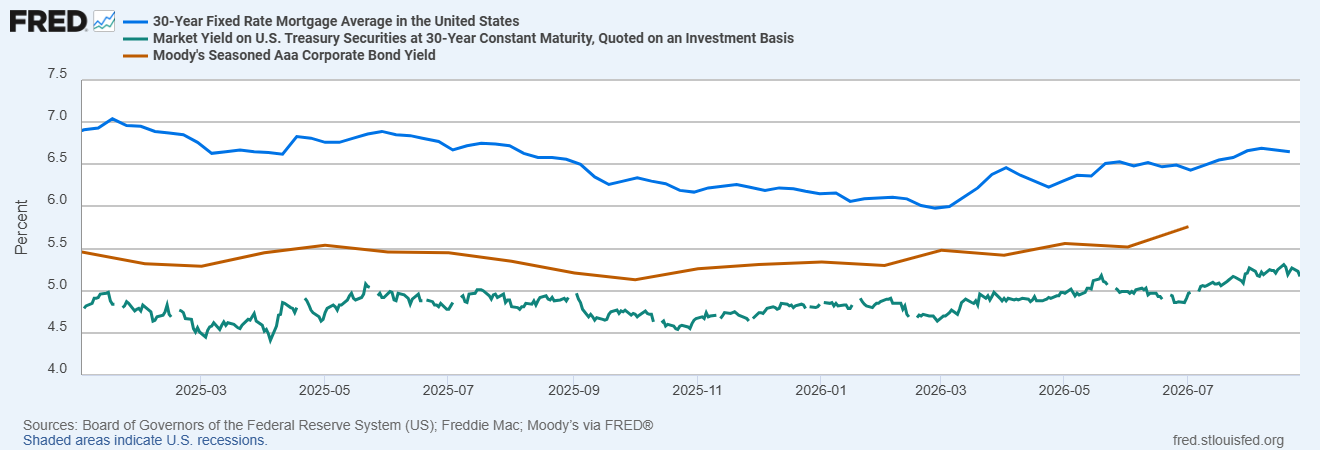
While there are specific factors affecting each market, the interest rates in each market are related. Corporate bonds and mortgage loans are riskier than Treasury securities and consequently have higher interest rates, so increasing Treasury yields will put upward pressure on both corporate bond yields and mortgage rates. As Treasury yields climbed in 2026, generally so did corporate bond yields and mortgage rates. The AAA corporate bond yield rose from 5.34% in January to 5.76% in July. The 30-year fixed mortgage began the year at 6.16% and climbed to 6.69% in early August. In addition to the yield on Treasury securities, the yield on AAA corporate bonds is affected by the demand for and supply of the bonds, inflationary expectations, and the default risk of the bonds. Factors affecting mortgage rates include the demand for loans by home buyers, home prices, inflationary expectations, and available funds by financial institutions.
When conducting monetary policy, the Federal Reserve targets the fed funds rate, a very short-term interest rate. After three rate cuts in 2025 due to a softening labor market, the fed funds rate closed the year at a target range of 3.50-3.75. No changes to the fed funds rate occurred in 2026 through August, as inflation remained above the Federal Reserve’s 2% target level. Although the targeted fed funds rate remained constant in 2026 through August, long-term interest rates rose due to factors affecting long-term interest rates.
The Rise in Long-term Interest Rates
- Increased Borrowing
Increased borrowing, by both the U.S. government and corporations, has placed upward pressure on interest rates, as an increased supply of bonds requires higher interest rates to attract more money from investors. According to the Securities Industry and Financial Market Association (SIFMA), corporate bond offerings increased significantly in 2026. The 2026 year-to-date corporate bond issuance through July was $1,681.0 billion, a 26.9% increase over 2025. Increased spending by companies investing in artificial intelligence and data centers played a major role in the rise of bond offerings in 2026. According to Yahoo! Finance, Goldman Sachs estimated $489 billion of AI-related debt had been issued through late July this year, exceeding an estimated $322 billion for all of 2025.
According to Vanguard, hyperscaler offerings have become a growing presence in the bond market, with hyperscaler offerings totaling approximately $132 billion and comprising 11% of investment grade bond offerings through July. A hyperscaler (including Alphabet, Amazon, Meta, Microsoft, and Oracle) is a company that operates massive, globally distributed data center and cloud computing infrastructure on an enormous scale.
Accelerating government borrowing has joined the increasing corporate borrowing to put upward pressure on long-term interest rates.
Except for a brief period between 1998 and 2001 when the U.S. was enjoying excellent economic growth and the tech boom in its internet infancy, the United States has had budget deficits since 1980. To finance a budget deficit, the government borrows money from the public through the issuance of U.S. government debt – Treasury securities. The total federal debt outstanding represents the total (principal) amount of Treasury securities outstanding issued by the federal government. Generally, the federal debt outstanding reflects the accumulation of budget deficits, with subsequent budget deficits increasing the federal debt.
Between 1980 and 2010, federal debt rose from approximately $1 trillion to $13 trillion. Federal debt rose to almost $20 trillion by the third quarter of 2016. In the past decade, the federal debt has exploded, more than doubling to over $40 trillion in August. That is not expected to change anytime soon, as the Congressional Budget Office expects a budget deficit of approximately $2.1 trillion in fiscal 2026 (yearend September). Interest on the debt is now the second largest government expense, trailing only Social Security. The U.S. now spends more on interest in servicing the federal debt than on Medicare or national defense.
- Inflation
Inflation places upward pressure on interest rates as lenders require additional return for the loss of purchasing power over time. Rising prices have stubbornly and persistently remained above the Federal Reserve’s long-run inflation target of 2% for personal consumption expenditures.
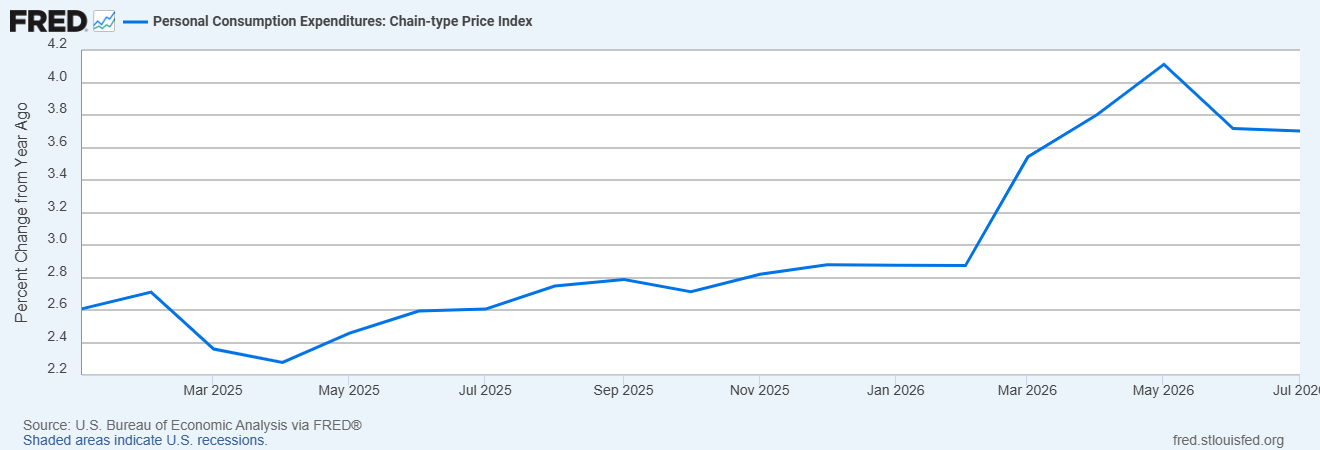
The chart below shows the 12-month price change for personal consumption expenditures from January 2025 through July 2026. Inflation bottomed out at 2.3% in April 2025 before beginning a general, steady climb through the rest of the year. By December, inflation for personal consumption expenditures had reached 2.9%. In 2026, inflation began the year at 2.9% in January before climbing to 4.1% in May. Although inflation dropped slightly to 3.7% in July, it was still significantly above the rate of one year ago, 2.6% in July 2025. Recently, tariffs and the war in Iran have been significant, contributing factors to inflation. The U.S. began implementing broad, global tariffs in April 2025. That is expected to continue, and the August implementation of 50% tariffs on select Canadian goods will only increase pricing pressures.
12-Month Price Change in Personal Consumption Expenditures
January 2025 – July 2026
- Foreign Demand for Bonds
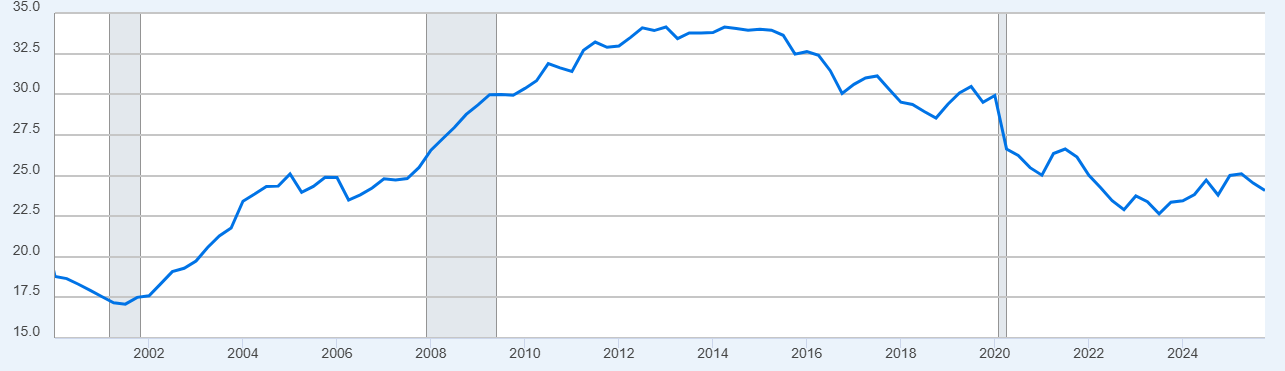
Foreign investors have played an important role in purchasing the Treasury debt used to finance U.S. budget deficits. However, the importance of that role is changing. The chart below shows foreign investor holdings of federal debt as a percentage of total federal debt held by the public between 2000 and 2025. In the first quarter of 2000, foreign investors held 18.9% of total federal debt. After slightly declining in 2001, the foreign investor holdings of federal debt as a percentage of total federal debt gradually rose to a peak of 34.1% in the first quarter of 2013. Since then, the rate has generally trended down, bottoming out at 22.6% in the third quarter of 2023. Although the rate rebounded to 25.1% in the second quarter of 2025, the foreign investor holdings of federal debt as a percentage of total federal debt decreased to 24.1% by the fourth quarter of 2025.
Generally, since 2013, the rate of growth of total federal debt held by the public has exceeded the rate of growth of foreign investor holdings of federal debt. The general decrease in the percentage of total federal debt held by foreign investors means that other investors are needed to purchase the additional Treasury securities used to finance the U.S. government. This places upward pressure on interest rates, as more investors need to find Treasury securities attractive for investing.
Foreign Investor Holdings of Federal Debt as a Percentage of Total Federal Debt Held by the Public
2000 – 2025
The table below shows the top five countries holding U.S. Treasury securities and compares the total amount of Treasury securities held in June 2026, January 2026, and June 2025. Japan held the top spot in each time period, investing in $1.1 trillion of U.S. Treasury securities in June 2026. The U.K. held second place and ramped up its investing in Treasury securities by $84.3 billion between June 2025 and June 2026, an increase of 9.8%. Although China was third in each time period, China significantly decreased its holdings of Treasury securities by $98 billion between June 2025 and June 2026, a decrease of 13.4%. Belgium and Canada round out the top five, with each increasing their investment in Treasury securities between June 2025 and June 2026 by 12.1% and 4.7%, respectively.
Foreign Holdings of U.S. Treasury Securities (billions of dollars)
| June 2026 | Jan 2026 | June 2025 | |
| Japan | 1116.7 | 1225.3 | 1154.8 |
| United Kingdom | 939.9 | 879.8 | 855.6 |
| China, Mainland | 633.4 | 695.3 | 731.4 |
| Belgium | 482.5 | 451.0 | 430.3 |
| Canada | 459.6 | 395.8 | 438.9 |
| Total of All Foreign Holdings | 9299.0 | 9291.33 | 9093.6 |
Foreign investors have played an important role in financing U.S. budget deficits through the purchase of Treasury securities. However, the explosion of U.S. federal debt has exceeded the growth of foreign investor ownership of federal debt. U.S. trade wars, the war with Iran, other political factors, and the rapid increase in federal debt may decrease the attractiveness of Treasury securities to foreign investors. If foreign investor ownership of Treasury securities does not keep pace with the growth in federal debt, or even declines, then additional investors will have to be found to purchase the increase financing required by rising U.S. federal debt.
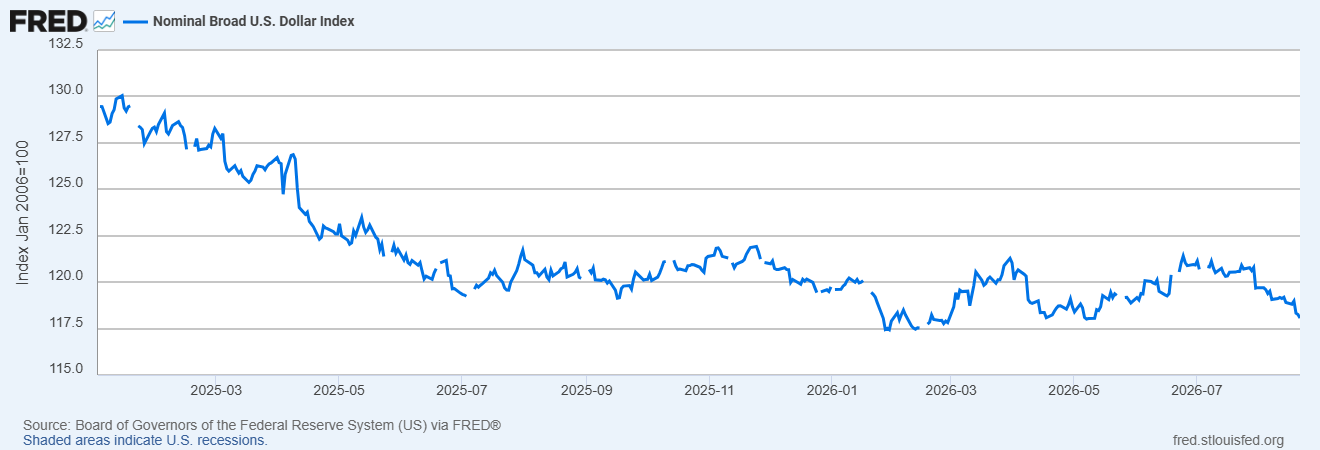
Another factor that may contribute to making investments in Treasury securities less attractive for foreign investors– a weakening U.S. dollar. The value of the dollar has important implications for international trade and investing. The chart below shows the Broad U.S. Dollar Index since January 2025. The Broad U.S. Dollar Index measures the value of the U.S. dollar against a broad basket of foreign currencies, weighted by the importance of each country’s trade with the United States. The index declined from 129.46 on January 2, 2025 to 118.06 on August 21, 2026, a drop of 9.6%. When the dollar declines, the value of the dollar is worth less relative to foreign currencies, which makes the imports of foreign goods more expensive as it takes more U.S. dollars to purchase foreign goods. Investments in U.S. Treasury securities may become less attractive, as the dollars received from the Treasury investment are worth less in terms of the foreign currency.
Broad U.S. Dollar Index (Nominal)
January 2, 2025 – August 21, 2026
Summary
In August, the Treasury announced a significant increase in its purchase of long-term Treasury securities in an effort to lower long-term interest rates, which would lower financing costs for consumers and businesses. While the Treasury action may temporarily lower long-term rates, it doesn’t fix the problems causing long-term rate increases. The significant growth in federal debt combined with the rapid rise in corporate borrowing fueled by AI expansion, inflation, and the attractiveness of Treasury securities for investing by international and domestic investors are the factors that need to be addressed to solve the challenges of rising long-term interest rates.
For further information:
- From the U.S. Treasury:
- From the Federal Reserve:
- From Forbes: Treasury Is Buying Its Own Bonds. Where Is The Money Coming From?
- From the University of Chicago: How Quantitative Easing Actually Works | Chicago Booth Review
- From SIFMA
- From Yahoo! Finance: Tech’s AI debt boom, in one chart
- From Vanguard: The AI buildout comes to the bond market | Vanguard
- From NPR: The U.S. debt tops a record-shattering $40 trillion: NPR
- From the Congressional Budget Office: Monthly Budget Review: July 2026 | Congressional Budget Office
- From the U.S. Treasury, foreign holdings of Treasury securities: ticdata.treasury.gov/resource-center/data-chart-center/tic/Documents/slt_table5.html

Kevin Bahr is a professor emeritus of finance and chief analyst of the Center for Business and Economic Insight in the Sentry School of Business and Economics at the University of Wisconsin-Stevens Point.